
About Kitayama Dojo

About
KITAYAMA DOJO
Serious Aikido does not mean harsh or aggressive training.
It means sincere, thoughtful practice rooted in principle, discipline, respect — and functional clarity born from martial discipline, with the quiet sharpness required in real encounters.
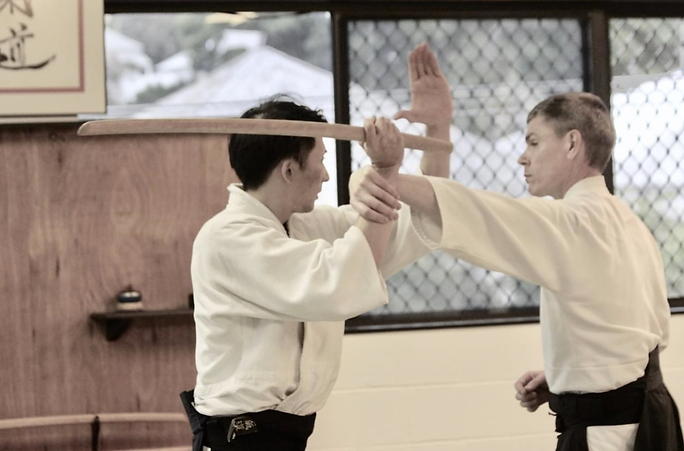
Firstly, we would like to introduce Kitayama Dojo’s “Three Principles of Self-Defense”:
-
Protecting the Body – Defense against physical threats such as violence.
-
Protecting the Mind – Defense against psychological challenges such as stress.
-
Protecting the Health – Defense against health-related risks such as illness and injury.
At our dojo, we combine the principles of Aikido’s physical self-defense and mental discipline with our own unique warm-up exercises derived from KAPPO (traditional Japanese myo-postural therapy).
This approach allows students not only to study Aikido techniques, but also to improve their overall health and physical awareness.
This commitment is deeply reflected in our Three Principles of Self-Defense, which guide all of our training.
Having lived abroad for many years, I have often heard people speak about the positive mental and philosophical aspects of Aikido. At the same time, Aikido is sometimes misunderstood by practitioners of other martial arts as being overly soft or gentle in appearance.
Rather than reacting to such views, our dojo chooses to focus carefully on the fundamental principles that underpin Aikido.
In particular, we place strong emphasis on the sword principles (Ken no Riai) and on exploring techniques that do not depend on physical strength or speed.
Instead, we study how effectiveness emerges through precise control of Distance, Timing, Angle, and Softness. Surpassing strength and speed requires subtlety, accuracy, and consistency.
Mastering these elements is not easy; it demands patient, long-term practice and careful self-reflection.
This is where the mental discipline found in Japanese martial arts, including Aikido, becomes especially important.
Through sincere training, practitioners begin to notice small discoveries and gradually develop the ability to perceive what cannot be seen, while maintaining a humble and open mind.
Many masters have shared with me the idea that “Aikido is rooted in the movement of the Japanese sword, and therefore we must practice with the BOKKEN.”
Although I am still learning and do not consider myself an expert, focusing on Ken no Riai has helped me better understand the subtle challenges of distance, timing, angle, and softness within Aikido techniques.
I have been deeply inspired by masters who demonstrated how even the most basic Aikido techniques can become sharp, powerful, and effective through a shift in perception rather than an increase in force — much like the image of an elderly samurai calmly overcoming a younger, stronger opponent.
For those beginning their Aikido journey at our dojo, we encourage a sincere focus on mastering the fundamentals without relying on strength or speed. By keeping the principles of the sword in mind and practicing with care and consistency, students can gradually cultivate both technical clarity and deeper understanding.